Beirut 1 – Rebuilding Confidence: A Turning Point for Lebanon’s Economic Recovery
By Hicham El-Moukammal
President of the Lebanese Tax Association
Member of RDCL
The “Beirut 1 – Rebuilding Confidence” Conference, held in the last quarter of 2025, constituted a national and economic milestone of great importance. It reaffirmed that Lebanon—despite the crises, wars, and collapses it has endured—remains capable, and indeed prepared, to rise again through the determination of its people and with the support of its Arab brothers and international friends. The gathering of a large number of Arab, foreign, and Lebanese investors—resident and expatriate—alongside international institutions and funds, in itself sent a clear message that Lebanon has not fallen outside the circle of interest, and that elements of attractiveness remain in place when properly organized and presented.
The conference came to confirm that the path toward restoring confidence has effectively begun, and that the actions undertaken by His Excellency the President of the Republic, General Joseph Aoun, and HE. Prime Minister Judge Nawaf Salam, are being translated into clear and gradual reform steps. Since the Presidential oath speech, a state-rebuilding project encompassing all its components has taken shape, based on a roadmap centered on restoring security across all Lebanese territory, combating corruption, restructuring public administrations, controlling borders and combating smuggling, addressing the financial crisis, restructuring the banking sector and guaranteeing deposits, stimulating investment, and strengthening judicial independence—all with the aim of restoring Lebanon to its natural role as an effective bridge between East and West.
The Economic Roadmap: A Methodical Vision and Promising Investment Opportunities
During the conference, Minister of Economy and Trade Dr. Amer Bisat presented a comprehensive investment roadmap aimed at restoring confidence in the Lebanese economy through clear executive steps that the government has already begun implementing and will continue in the next phase. His presentation included a detailed breakdown of the public and private sectors capable of attracting investment, as well as the expected feasibility and profitability within a short timeframe. He emphasized that the current period represents an optimal moment for investment, coinciding with the broader effort to rebuild state institutions and reactivate the economic cycle.

For his part, Mr. Charles Arbid, President of the Economic, Social, and Environmental Council, stressed that Lebanon always rises from beneath the rubble, and that its true value lies in the initiatives of its people, the energy of its youth, and its constant capacity for innovation and creativity. He recalled that Lebanon is not only nature, tourism, and cuisine, but also an investment haven par excellence whose opportunity must not be squandered.
Sectoral Conference Sessions: A Clear Reform Landscape and a Precise Progress Roadmap
The conference witnessed a series of high-quality sectoral dialogue sessions, during which ministers and concerned officials presented detailed and transparent overviews of what has been achieved and what remains underway.
Minister of Finance Yassine Jaber confirmed the launch of a financial and tax reform process, pointing to the expected surplus in the 2025 budget, followed by larger surpluses in 2026. This, he noted, would strengthen prospects for a forthcoming agreement with the International Monetary Fund and reduce waste, corruption, and customs and tax evasion.
The Governor of Banque du Liban explained that work is ongoing to strengthen the governance of the central bank and to put in place decisive solutions to guarantee deposits and address the financial gap, while emphasizing exchange-rate stability and reinforcing the value of the Lebanese pound.
Former Minister Mohammad Choucair stressed that the private sector has preserved the pulse of the economy over the past five years, and that continued investment despite the crisis constitutes clear proof of internal confidence in the country. This has been reflected in a noticeable increase in the number of new factories, particularly in the food, pharmaceutical, and agricultural industries, in addition to Gulf hotel investments and tourism and service projects.
Minister of Public Health Dr. Rakan Nassereddine presented a detailed overview of measures taken to support public hospitalization, patients suffering from chronic and cancer-related diseases, as well as plans to rehabilitate public hospitals.
Minister of Social Affairs Haneen Sayed presented the social survey program and the plan to digitalize files in order to enhance employment opportunities based on individual capabilities. Minister of Agriculture Nizar Hani outlined an integrated program to support modern agriculture, cooperatives, and farmers.
In the energy sector, Minister of Energy and Water Joe Saddi presented renewable energy projects and investment pathways, while Minister of Tourism Laura Lahoud outlined the ministry’s plan to attract investors according to a clear timeline.
On the infrastructure front, Minister of Public Works and Transport Fayez Rasamny reviewed progress on the files of the Ports of Beirut and Tripoli, in addition to plans to rehabilitate Qlayaat Airport and develop other facilities.
Minister of Industry Joe Issa El Khoury highlighted the progress achieved in the digitalization of the Ministry and the improvement of industrial performance, pointing to the global successes of the Lebanese industrial sector—foremost among them the international achievements of RDCL President Mrs. Joumana Saddi Chaya in the field of premium lighting with Lebanese manufacturing and design, as well as industrial projects in agriculture and robotics now exported from Lebanon to the United States, Germany, and other countries.
In the same context, Minister Kamal Shehadeh emphasized the importance of digitalizing the state as a gateway to transparency and combating corruption and bureaucracy, outlining measures taken toward digital transformation across public administrations. Minister of State for Administrative Development Dr. Fadi Makki explained the merit-based appointment methodology and steps adopted to digitalize the ministry and increase productivity.
Meanwhile, Mr. Nicolas Chammas, Secretary General of the Economic Bodies, stressed the interconnectedness of economic sectors, noting that any industrial or investment expansion would inevitably reflect positively on trade and the broader economic cycle.
The Prime Minister’s Address: State Sovereignty and Reform as a Firm and Ongoing Choice
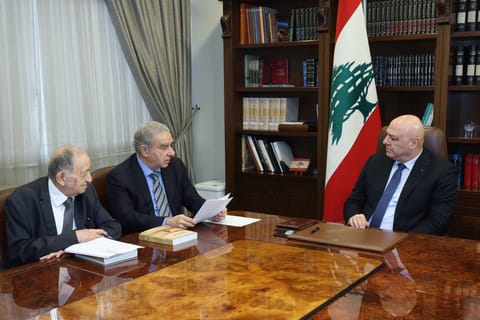
In the closing session, Prime Minister Judge Nawaf Salam affirmed that the government is moving forward in asserting state sovereignty across all Lebanese territory and that the reform path will not stop. He stressed the protection of depositors’ funds and progress toward concluding the financial gap law, and announced the completion of amendments to the Public-Private Partnership Law and its referral to Parliament for approval. He praised Arab and international participation in the conference—particularly the Saudi delegation—and reaffirmed efforts to restore Lebanon to its natural position within the Arab sphere.
Beirut 1: A Platform for Opportunities, Not a Stage for Appeals
The initiative undertaken by Minister Amer Bisat in organizing the Beirut 1 Conference constitutes a foundational step in re-presenting Lebanon as a country of opportunity and investment rather than a country of crises. The conference was not a platform for requesting aid, but rather a forum for presenting real opportunities and launching potential partnerships between Lebanon and Lebanese, Arab, and foreign investors, based on brotherly relations and the international community’s confidence in Lebanese capabilities.
What is required today is to invest in this momentum by preparing complete investment files across all sectors and presenting them to Arab and international investors and funds, opening the door to an execution phase that translates the conference’s outcomes into concrete agreements and near-term projects.
A Launch Window Toward a New Economic Phase
The Beirut 1 Conference was not a passing event, but a genuine launch point for a long-awaited path: rebuilding the state, achieving economic recovery, and restoring confidence. With the continuation of this approach through subsequent conferences, Lebanon can finally open a new chapter that consolidates stability and reactivates the economic wheel with the support of its Arab and international partners.